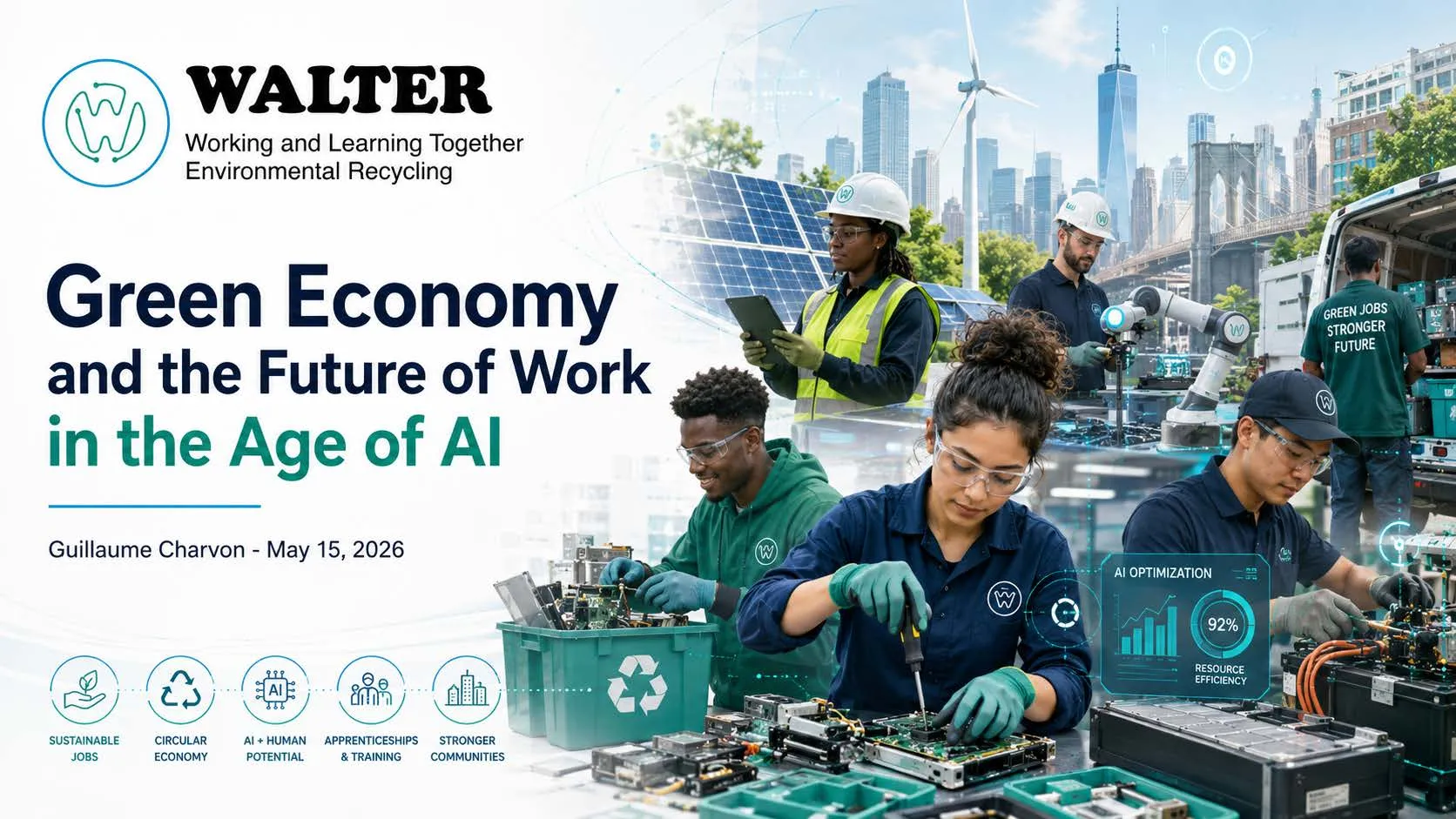
Green Economy and the Future of Work in the Age of AI
AI is reshaping the labor market and making traditional paths to mobility less predictable. But the green economy offers another path forward: one built on technical skills, apprenticeship, circular economy work, and human judgment. In this reflection, we explore how green jobs can become a new engine of social mobility, especially for communities too often excluded from traditional career pathways.
In the United States, 35.9 million Americans lived below the official poverty line in 2024, according to the U.S. Census Bureau. But the deeper issue is not only the number of people in poverty today. It is the persistence of poverty across generations.
Research from Pew found that 43% of Americans raised at the bottom of the income ladder remain there as adults, and 70% never reach the middle. For millions of families, poverty is not a temporary condition. It is a structure that carries forward. And if poverty is reproduced by systems, mobility must also be built through systems.
Today, AI is transforming the labor market and making some traditional paths to mobility harder for a new generation. The entire job market landscape is changing. Ladders into stable work are becoming less predictable.
But another path to social mobility is emerging beyond this uncertainty: the green economy.
The green economy can create career paths that are resilient to AI, grounded in real economic demand, and accessible to people too often excluded from traditional routes to success. New York City’s recently announced Green Economy Action Plan is moving in the right direction.
Welders, electricians, battery technicians, computer technicians, solar installers, recycling specialists, robotics operators, and decommissioning teams will be needed. We will need workers across the full life cycle of renewable infrastructure: installation, maintenance, repair, recycling, and decommissioning.
At WALTER, we see this already in the circular economy: e-waste, decommissioning, logistics, sorting, repair, and responsible material recovery all require technical discipline, human judgment, and increasingly, the ability to work with digital and AI-enabled tools.
This new market is also shaped by powerful geopolitical forces, including the race to secure critical minerals, green energy production, energy storage technologies such as batteries, and energy distribution infrastructure. But its consequences will be very local: new work, new skills, and new opportunities in communities across the country.
The job market will be there. But the workforce pipeline needed to meet it at scale is not yet fully built.
The earliest stages of that pipeline — recruiting talent from communities too often left behind, exposing people to these careers, and helping them build skills over time — remain underdeveloped.
This is where public and private actors have a responsibility to act.
We need mechanisms that tap into the talent pool we currently overlook. We need to reach people whose path to success has too often been defined by the idea that college is the only route to opportunity.
We need to ask ourselves questions like: what should training and knowledge transmission look like in the age of AI?
Apprenticeship should not be treated as a second-class option. It should be understood as a path to mastery.
The next generation of high-opportunity jobs will be on the ground. They will be technical. And they will increasingly be hybrid, combining human beings with AI, robotics, and advanced tools in the field.
I believe the green economy can help reestablish apprenticeship as one of the great engines of social mobility. Organizations such as St. Nicks Alliance are already pursuing this path, as are many others. But isolated programs will not be enough.
We need to start building the ecosystem now, so that when capital and infrastructure are deployed, the workforce is ready.
This is not only an economic question. It is a social question. It is a national security question. And it is a question of dignity for all.
Where there are high stakes, there is high opportunity.
“A note of gratitude to the St. Nicks Alliance Business Advisory Council, and to the workforce leaders whose insights helped shape this reflection: Joanne Walker; Sandra Blackman (Workforce Development Project Director at NYPA); Kiernan Kelly (Workforce Development Program Manager at NYPA); and Amber Rangel (Director of NY Workforce Development at National Grid). Conversations with them helped ground this piece in the practical work of building workforce pathways, and their initiatives are inspiring.”